High above the fertile plains near today’s village of Pojan, the ancient city of Apollonia rises from the hills with quiet grandeur. Founded slightly later than Dyrrhachium, this remarkable settlement began its story in 588 BC, when colonists from Corinth and Corcyra crossed the Ionian Sea to establish a new outpost along the Adriatic world.
According to ancient tradition, recorded by Stephanos of Byzantium, around 200 Corinthians led by Gylax first named the settlement Gylaceia. Not long after, the city was renamed Apollonia, in honor of Apollo, the divine protector associated with its foundation. Its location—near the sea and close to the river Aoos (today’s Vjosa)—was ideal for trade, agriculture, and maritime power.
Yet this was not an empty land. To the north lived the Illyrian Taulantii, and as Stephanos himself notes, “Apollonia was first inhabited by the Illyrians, as was Epidamnos.” The colony likely rose at a cultural frontier—between Illyrian tribes and the Hellenized populations of Epirus to the south. For this reason, the city became widely known in antiquity as Apollonia of Illyria (or Illyricum).
By the 4th century BC, Apollonia had emerged as one of the most prominent cities of the Adriatic basin. In fact, among more than 30 ancient cities bearing the same name, this Apollonia was mentioned most frequently in classical sources. Aristotle, writing in the 4th century BC, describes its oligarchic system of governance—generally understood to mean that descendants of the Greek colonists maintained political control over a larger indigenous population.
A Maritime Power of the Adriatic
Apollonia’s prosperity rested on three pillars: trade in slaves, pastoral agriculture from its rich hinterland, and a powerful harbor capable—according to tradition—of accommodating up to one hundred ships at a time. It was a thriving commercial crossroads linking the Balkans with the Mediterranean world.
But the Balkans have rarely been quiet ground.
In the mid-5th century BC, Apollonia clashed with Illyrian formations. The city famously plundered Thronium, an Amantian settlement. This victory was commemorated in an inscription discovered at Olympia (modern Mavrova, on the road to Amantia), which proclaims:
“We are here to recall Apollonia, which Apollo of the unshorn hair founded by the Ionian sea; they captured the edges of the Abantian land and set this up here, a tithe taken from Thronium, with the help of the gods.”
Control over Thronium brought Apollonia access to the valuable bitumen mines and the sacred oracle of Nymphaeum—today associated with the area of Selenica.
During the Peloponnesian War, the city aligned itself with Athens and Corinth against Sparta, Corcyra, and the Illyrian state. Political tides shifted over time. By 350 BC, the Illyrian king Monun had placed his name on Apollonian coinage—a sign interpreted by many historians as an indication of Illyrian political influence over the city. For a period, Apollonia was also incorporated into the dominions of Pyrrhus of Epirus (297–272 BC). Later, from 214 BC onward, it became entangled in conflicts between the Taulantii and Cassander of Macedonia.
Under Rome: A City of Influence
In 229 BC, Apollonia came under the authority of the Roman Republic. Its loyalty to Rome proved beneficial: in 168 BC, it was rewarded with spoils taken from Gentius, the defeated Illyrian king. By 148 BC, Apollonia became part of the Roman province of Macedonia, specifically within Epirus Nova. Toward the end of the 2nd century BC, the region was organized into the provinces of Illyricum and Macedonia.
Despite Roman dominance, Apollonia retained the prestigious status of civitas libera et immunis—a “free and tax-exempt city.” It preserved the right to use the Greek language and mint its own coins.
The Roman orator Cicero referred to it in his Philippics as magna urbs et gravis—“a great and important city.” Its strategic importance grew further as it became one of the principal gateways of the trans-Balkan Via Egnatia. A later Roman road connected Apollonia westward to Aulon (modern Vlora) and southeastward to Hadrianopolis and Nicopolis.
During the Roman Civil War between Pompey and Julius Caesar, Apollonia supported Caesar. In 45–44 BC, the young Octavian (later Emperor Augustus) studied rhetoric there for six months under Athenodorus of Tarsus, accompanied by his friend Agrippa. It was in Apollonia that Octavian received news of Julius Caesar’s assassination—an event that propelled him toward Rome and ultimately toward imperial power.
Pax Romana and a Distinct Identity
Under the Pax Romana, Apollonia flourished anew. The many monuments erected during this era testify to its wealth and cultural vitality. Throughout its history, the city maintained a strongly Greek cultural character. Yet its economic independence and close ties with the Illyrian hinterland gave it a distinctive personality—neither purely Greek nor purely Illyrian, but uniquely Apollonian.
Earthquake, River, and Decline
After centuries of stability, decline began gradually. In the 3rd century AD, the wider crisis affecting the slave-owning Roman world reached Apollonia. The decisive blow, however, came from nature. A powerful earthquake in the same century altered the course of the river Aoos (Vjosa), shifting it approximately 9 kilometers southward. The harbor silted up, and the surrounding lowlands turned into a malaria-ridden marsh. Cut off from maritime trade, the city faded.
As Apollonia waned, another settlement rose further south near present-day Vlora: Aulona.
The Last Echoes
Even as the population diminished, a small Christian community endured. Ecclesiastical records reveal that at the Council of Ephesus in 431, a bishop named Felix signed as Bishop of Apollonia and Byllis. Some scholars believe the two cities formed a single episcopal see; others suggest Felix was Bishop of Apollonia who temporarily administered Byllis.
At a council in Constantinople in 448, a Paulus signed as Episcopus Apolloniada al. Apolloniatarum, though it remains uncertain whether this refers to the same Apollonia. In 451, at the Council of Chalcedon, Eusebius signed simply as Bishop of Apollonia. Later, in 458, Philocharis appears in correspondence to the Byzantine Emperor Leo I, possibly linked to Byllis—though scholars debate whether his authority also extended to Apollonia.
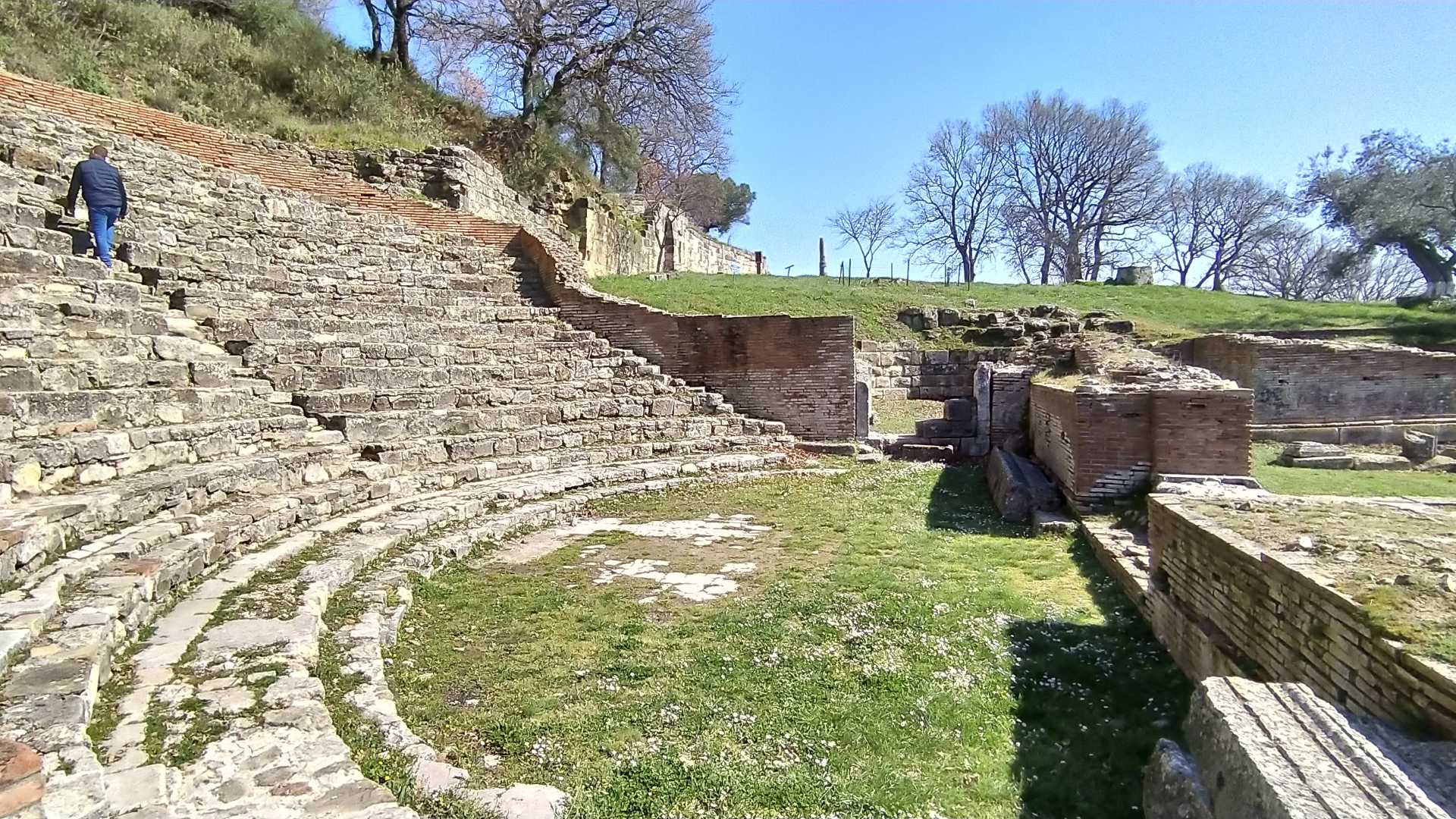
Today, walking among the colonnades, the odeon, and the monastery walls built atop ancient foundations, visitors encounter more than ruins. They stand at a crossroads of civilizations—where Illyrian tribes, Greek colonists, Roman statesmen, and early Christian bishops once shaped the destiny of a city that bridged worlds.